
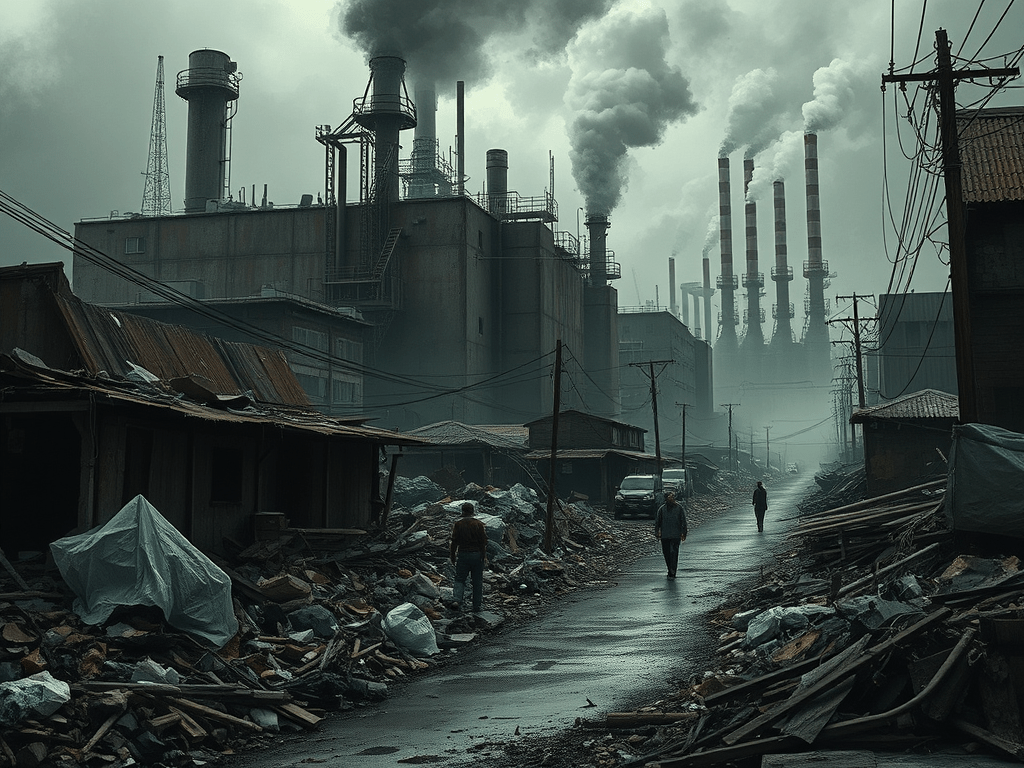

Climate change is a social issue that has a massive impact on many facets of public life. When discussing climate change, many people rightfully think of the impact it has on the world scale. Areas such as global food and water supply, forced migration, and public health are the most commonly known factors, but the lesser known, yet wildly significant challenges of the climate crisis lies in addressing the disproportionate climate-related risks to BIPOC communities, and the call for scientist activism as a necessary social response required to fix it.
The term BIPOC stands for Black, Indigenous, and people of color. The purpose of the term is to recognize the systemic racial injustices that disproportionately affect Black and Indigenous communities. Climate change is one such societal issue that impacts BIPOC communities more than others. This is the core of the issue that Erika Spanger-Siegfried, Director of Strategic Climate Analytics in the Climate and Energy program at the Union of Concerned Scientists, attempts to shed light on in her article titled, Confronting the Climate Crisis with Scientist Activism: the Essential Role of Rule Breakers. The solution she proposes is for privileged groups within the scientific community to increase their activism and offset the unbalanced repercussions associated with challenging the system.
BIPOC individuals experience heavier consequences related to climate change. A study on the inequity of consumption of goods and services and how it adds to racial-ethnic disparities in air pollution exposure found that non-Hispanic Whites experience a “pollution advantage,” while those who identify as Black or Hispanic suffer a “pollution burden.” If we look at the Hispanic population, they produce 31% less air pollution, yet are exposed to 12% more, on average. The black community produces 23% less but are exposed to 21% more. The White community, though, produces 12% more air pollution and is exposed to 7% less than what they are producing (Tessum, 2019). The health consequences of this disparity reflect the effects of this inequitable relationship.
Hispanic and Black communities are much more likely to experience health damage due to air pollution exposure, while White communities are less likely, despite the fact that their group is the primary contributor to the issue. This phenomenon is known as “pollution inequity,” and explains “the extent to which groups disproportionately contribute to or bear the burden of pollution” (Tessum, 2019). The same study found that the Black community has a pollution inequity of 56%, the Hispanic community 63%, and the White community a pollution inequity of –17%. The negative value expressed in the White community means that this group experiences less health damage than they cause. In addition to bearing heavier consequences, BIPOC activists also experience heavier repercussions for their civil disobedience than their White peers in their efforts to rectify it. According to Spanger-Siegfried, “for less-privileged activists, especially Black, Indigenous, and other activists of color, and in the global South, people have been targeted and killed for their activism” (Spanger-Siegfried, 2023).
The moral dilemma of the “well-behaved” scientist is this, “If you can see the devastating future of climate change- in the data and evidence and catastrophic events that continue to accelerate- when others cannot, how should you behave?” (Spanger-Siegfried, 2023). Essentially, at what point should scientists abandon the social rules, norms, and expectations society places on them in order to better serve society? – and how does that decision affect the way society will view them and the legitimacy of their social role in the future?
According to Gianluca Grimalda, an Italian researcher in social psychology and spokesperson for the climate action group Scientist Rebellion, “Science should be communicated for what it is,” adding that “Scientists have a duty, to tell the truth” (McKenzie, 2022). Scientist Rebellion is a global movement for climate action that promotes civil disobedience as a method of building environmental awareness in an effort to mitigate the disastrous effects of climate change. The group reinforces the notion that scientist activists need to put their professional standing and privilege to use and protect activists with less privilege who might be disproportionately targeted for their efforts, and do so by breaking some rules, and engaging in civil disobedience in order to increase their impact on the cause.
So, how could sociologists generate more research into activism’s role in the scientific community? The issue itself can be best looked at from the top-down, rational viewpoint of conflict theory because it highlights the naturally occurring conflict between groups competing for resources and power and explores the conditions that led to the structural inequality of minority and BIPOC groups in relation to the effects of climate change on their respective communities (Manza, p.44).
Additional research could provide a clearer picture for organizational purposes as well. It could lead to an end stage of “normalcy bias,” but more importantly, it could lead to transformative action. The need for scientist activists to answer the call for climate justice is imperative to the movement. Though the social repercussions of civil disobedience may sometimes be steep, we must remind activists that “The integrity of climate science isn’t compromised by the activism of its scientists, but at some point, isn’t the integrity of climate scientists compromised by our inaction?” (Spanger-Siegfried, 2023.).
Works consulted
- McKenzie, Jessica. “Inside the Global Rebellion of Scientist-Activists Agitating for Climate Action.” Bulletin of the Atomic Scientists, 30 Aug. 2022, https://thebulletin.org/2022/08/inside-the-global-rebellion-of-scientist-activists-agitating-for-climate-action/.
- Spanger-Siegfried, Director of Strategic Climate Analytics, Erika, et al. “Confronting the Climate Crisis with Scientist Activism: The Essential Role of Rule Breakers.” The Equation, 19 Jan. 2023, https://blog.ucsusa.org/erika-spanger-siegfried/confronting-the-climate-crisis-with-scientist-activism-the-essential-role-of-rule-breakers/.
- Tessum, Christopher W., et al. “Inequity in Consumption of Goods and Services Adds to Racial–Ethnic Disparities in Air Pollution Exposure.” Proceedings of the National Academy of Sciences, vol. 116, no. 13, 2019, pp. 6001–6006., https://doi.org/10.1073/pnas.1818859116.
- Turner, Bryan S. The Cambridge Dictionary of Sociology, Cambridge University Press, Cambridge, 2006.
- Manza, Jeff. Sociology Project 3.0, The: Introducing the Sociological Imagination. Pearson, 2022. pp. 44-64.
Areas such as global food and water supply, forced migration, and public health are the most commonly known factors, but the lesser known, yet wildly significant challenges of the climate crisis lies in addressing the disproportionate climate-related risks to BIPOC communities, and the call for scientist activism as a necessary social response required to fix…




 Jenny Lynx Blog
Leave a comment