
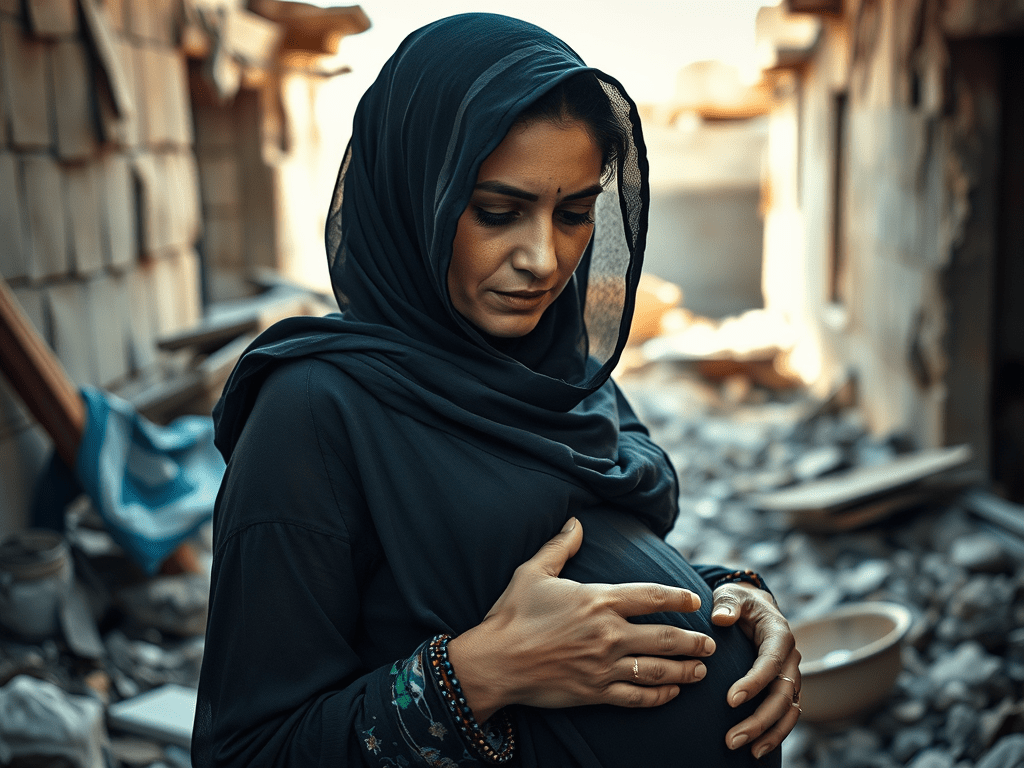
In times of war, it is not often we hear about the unique effect violent conflict has on women. In addition to violence and death, there are a number of physical, mental and hygienic issues women face in these trying times that many people may not be aware of. Lack of access to OB/GYN services, lack of menstrual health care and personal hygiene products and lack of mental health care, as well as an increase in mental health issues, and neonatal and postnatal obstacles. The most devastating global conflict of today where these issues can be observed is the violent war taking place in occupied Palestine between the State of Israel and the armed resistance group, Hamas. To summarize this conflict is no easy task. While military forces have battled one another over the territorial rights to the land, native Palestinian civilians have long endured grueling conditions of racial apartheid, ethnic cleansing, and mass displacement. For the women of Palestine, though, this war has additional barriers that often go unnoticed or unaddressed.
According to the United Nations, as of 5 March 2024, it was estimated that 155,000 women in Gaza were pregnant or breastfeeding, and an additional 5,500 were expected to deliver by April, all within an environment where 37 mothers are killed per day (United Nations, 2024). By May, a press release by the United Nations reported that the dire conditions have caused miscarriages to increase by up to 300 percent, and for those who do make it to delivery, an excess of 183 women are giving birth each day without the assistance of pain relief, while hundreds of babies have died due to a lack of power to incubators and 95 percent of pregnant and breastfeeding women face severe poverty (United Nations Human Rights office of the High Commissioner, 2024). It is astonishing how a nation such as the USA can find themselves so vocal in the right to life circles of anti-abortion lobbyists yet fall silent when it comes to the martyred children of Palestine.
Menstruating women and girls face their own set of issues. As a woman, I’ve certainly found myself in emergency situations where I was forced to get creative due to an early visit from the crimson tide, but such measures usually amounted to a makeshift toilet paper pad to hold me over while I run to the store to pick up what I need. But what do you do when even toilet paper is inaccessible, and there is no local store stocked with supplies? Lack access to sanitary products, has forced many women to resort to using tent scraps while others place plastic bags under them and pieces of cloth, or baby diapers that they can cut into pieces, according to one PFPPA healthcare worker (Awadallah, 2024).
In addition to the health and hygiene issues facing the girls and women of Palestine, reports received by the United Nations declared that many are also enduring targeted gendered violence, often sexual in nature, as a war tactic to intentionally humiliate them. The experts that generated these reports also expressed alarming concern regarding the arbitrary detention of hundreds of Palestinian girls and women and described the inhumane conditions, treatment and sexual exploitation they are being subjected to, noting how members of the Israeli army have even uploaded photos of female prisoners in degrading circumstances online (United Nations Human Rights office of the High Commissioner, 2024). This type of behavior not only subjects women and girls to physical abuse, but mental abuse as well, especially within a culture that deeply values female modesty. When paired with all the other issues facing Palestinian girls and women in the cross hairs of this conflict, it is no surprise they are also facing a severe mental health crisis and a strained relationship with the very nature of their womanhood.
A recent article published by the Carnagie Endowment for International Peace followed a 24-year-old Palestinian woman named Reham who was displaced and sheltering in Raffa. In just five months Reham had lost her home, her parents, her brothers, and her pregnancy due to shock, and now lives in a constant state of anxiety about who may be next (Shahd, 2024). When interviewed, her husband stated, “Before the attack, Reham was lovely and warm. It’s so depressing to see her like this—worn out and silent most of the time, when she was so talkative and social before. When my eyes meet her eyes, I feel how lost she is” (Shahd, 2024). According to Dr. Alice Rothchild, retired OB/GYN, author, filmmaker and former assistant professor at Harvard Medical School, “the only way for women and children to be healthy and free is to immediately stop the fighting. We need to restore necessary services and start to rebuild. This outcome requires the constant pressure of women and feminists across the globe” (Shahd, 2024). Dr. Rothchild highlights the need for global solidarity and the importance of bearing witness to these atrocities if we wish for them to end.
Lastly, the women and girls of Palestine also face a threat to their very identity as women. If you are paying attention to the images and videos coming out of Gaza, you will notice how most of the women are wearing a similar looking garment with a hijab attached. These are called prayer gowns, or ‘jilbab’ in Arabic, and are typically worn when Muslim women want to pray or run out for a quick errand, not for wearing out and about, yet almost every image coming out of Palestine depicts most women in these humble robes due to fear of being bombed and found uncovered. An article published in Al Jazeera followed four displaced Palestinian women and their families in Deir el-Balah, Gaza Strip to gain insight to the plight of displaced women in Palestine in honor of International Women’s Day last March. Nada Abdelsalam, 34, said she had forgotten what it means to be a woman adding how she, “feels ashamed to go outside her tent in the shabby, worn-out clothes she is left with” (Humaid, 2024). This wartime precautionary act of always wearing the jilbab really highlights the chaos of abrupt displacement and widespread uncertainty. Another woman named Sawsan al-Zein, 50, had lost an eye after her home was bombed by Israel, and now copes with the limitations her injury has placed on her ability to care for her children. Once the matriarch of her family, al-Zein took care of all household responsibilities, whether big or small, whereas now, since her injuries, she struggles to do basic chores like cooking or carrying certain objects (Humaid, 2024).
So what can be done about this? How can we solve this issue for not just Palestinian women, but all women living in war-torn regions around the world? Women in Sudan, the Democratic Republic of Congo, and Lebanon are all experiencing similar strife due to violent conflict beyond their control. Luckily there are agencies and organizations around the world who attempt to address these issues and help women in need. Organizations like UNICEF provide much needed support and assistance tending to the needs of women and children in Palestine by providing aid such as access to medical supplies, hygiene kits, mental health services, vaccines, and warm clothes, as well as nutritional supplements, food, water, and even humanitarian cash assistance for things they are unable to provide directly (UNICEF, 2024). There is also UNFPA, a branch of the United Nations and the agency responsible for the sexual and reproductive health and rights of women and girls across the globe (UNFPA, 2024). Women for Women International is another institution aimed at helping women in Palestine, and work with local organizations to provide services for marginalized women facing violence, instability, food insecurity, and unemployment in the area (Women for Women International, 2024). Lastly, there is the Women’s Peace and Humanitarian Fund. Their program works with local women’s organizations in Palestine and primarily works to prevent conflict, strengthen the economic resilience of women, and mobilize participation in peacebuilding efforts (WPHF, 2024). All of these agencies provide vital resources for women in Palestine undergoing such violence and devastation, and it is important to support such organizations to ensure that women in need receive the care they deserve.
One of the biggest differences in this conflict between today and its origins in 1948, or the escalations that followed throughout the years, is our ability as average citizens to share our lived experiences, en mass, in real time. For the first time in history, technology has provided everyday people with the ability to see the devastation with our own eyes outside of the prevue of those who wish to control the narrative with propaganda. Attending local protests and demonstrations, writing to your local and federal representatives, and donating to some of the organizations mentioned above are great ways to get involved and do what we can to end this cycle of violence and global strife against women. If time or money are barriers, one of the easiest things we can do as an individual is to simply bear witness to the suffering of the women and girls of Palestine and share their stories. Simply providing Palestinian women a platform to tell their story and confirm their humanity can immensely benefit families in need. Crowdsourcing and other grassroots efforts designed to help specific families and individuals can also make a direct difference to displaced Palestinians. A great one that includes a massive collection of resources is Operation Olive Branch and can be accessed on linktree at https://linktr.ee/opolivebranch. For the first time since the start of this conflict in 1948, citizens of the world can unite, share resources, and hold our representatives accountable in a way that has yet to be achieved. I believe this generation has the power to bring about an end to this conflict, and usher in a new phase of global society that is rooted in solidarity and values human dignity for all.
References
Awadallah, A. (2024, February 29). The forgotten women and girls in Gaza: a sexual and reproductive health catastrophe | Relief Web. https://reliefweb.int/report/occupied-palestinian-territory/forgotten-women-and-girls-gaza-sexual-and-reproductive-health-catastrophe
Humaid, Maram. 2024. “‘I Yearn for the Girl I Used to Be’: Gaza Women Tell Their Stories.” Al Jazeera. March 8, 2024. https://www.aljazeera.com/features/2024/3/8/a-suffering-i-would-not-wish-on-any-woman-women-of-gaza.
Safi, Shahd. 2024. “Palestinian Women in Gaza: Cruel Realities of Displacement.” Carnegieendowment.org. March 7, 2024. https://carnegieendowment.org/sada/2024/03/palestinian-women-in-gaza-cruel-realities-of-displacement?lang=en.
UNICEF. 2024. “The Challenges of Being a Woman Today in Gaza | UNICEF State of Palestine.” Www.unicef.org. March 8, 2024. https://www.unicef.org/sop/stories/challenges-being-woman-today-gaza.
UNFPA. 2024. “Home.” USA for UNFPA. 2024. https://www.usaforunfpa.org/.
United Nations. (2024, March 5). Facts and figures: Women and girls during the war in Gaza – un women – question of Palestine. https://www.un.org/unispal/document/facts-and-figures-women-and-girls-during-the-war-in-gaza-un-women-2/
United Nations Human Rights office of the High Commissioner. (2024, May 6). Onslaught of violence against women and children in Gaza unacceptable: Un experts | ohchr. United Nations. https://www.ohchr.org/en/press-releases/2024/05/onslaught-violence-against-women-and-children-gaza-unacceptable-un-experts
WPHF. 2024. “Palestine.” Women’s Peace and Humanitarian Fund. 2024. https://wphfund.org/countries/palestine/.
Women for Women International. 2024. “Palestine | Women for Women International.” Www.womenforwomen.org. 2024. https://www.womenforwomen.org/palestine.



 Jenny Lynx Blog
Leave a comment